 How-to
How to Choose the Right Skid Steer for Your Job
Last Updated: October 28, 2026
Quick Summary
To choose right skid steer for your job, start with the work rather than the machine: your heaviest lift, narrowest access, ground conditions, and attachment list. Match rated operating capacity, machine dimensions, undercarriage, lift path, and hydraulic flow to those answers, since usable lift is ROC minus attachment weight.
- Write down your heaviest lift, narrowest gate, ground conditions, and attachment list before shopping.
- Usable lift is rated operating capacity minus attachment weight, de-rated for load center.
- Keep your heaviest routine lift at or below 80 percent of ROC after subtracting attachment weight.
- Choose wheels for hard surfaces and tracks for soft ground, lawns, or muddy sites.
- Match the attachment's required flow to the machine's rated auxiliary flow, not total hydraulic flow.
Table of Contents
- Start With the Job, Not the Machine
- What Size Skid Steer Do I Need for My Project?
- Wheels or Tracks: Matching the Undercarriage to Your Ground
- Radial vs. Vertical Lift: Which Lift Path Fits Your Work?
- Hydraulic Flow and Skid Steer Attachments for Landscaping
- Skid Steer vs. Tractor: Which Machine Does Your Property Need?
- Skid Steer Rental for Residential Projects: What to Expect
- Book Your Skid Steer and Get It Delivered to Your Site
- Frequently Asked Questions
Start With the Job, Not the Machine
Most people start by asking which skid steer is best, the wrong first question when you need to choose right skid steer.
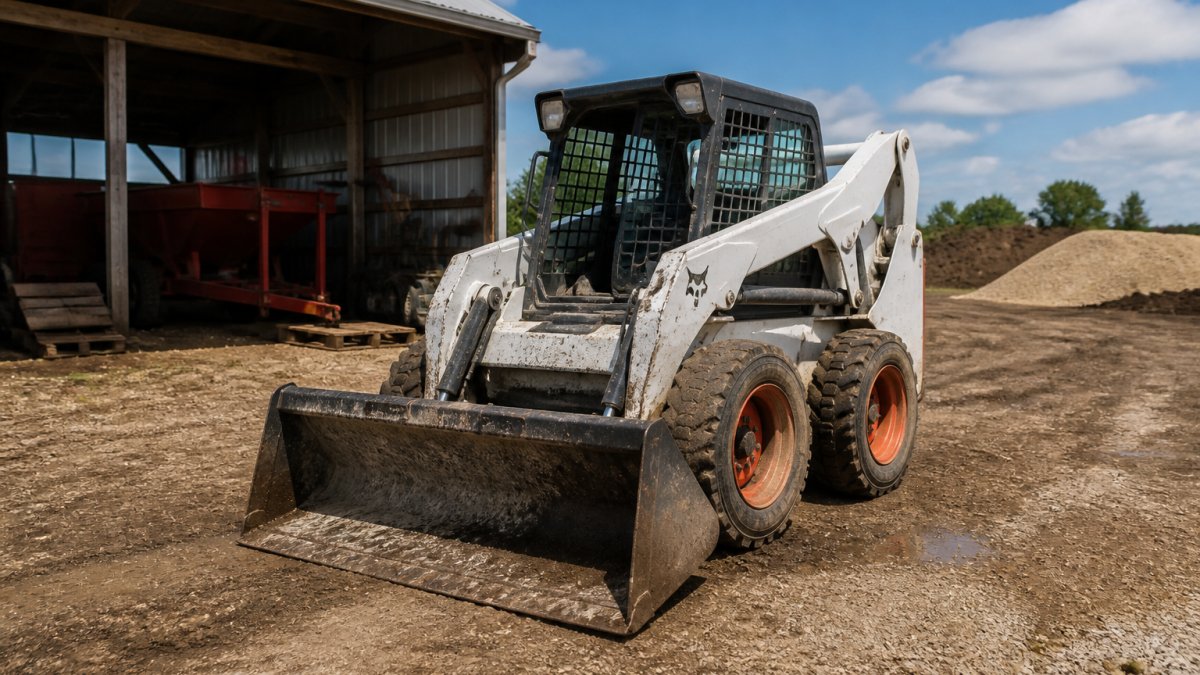
The skid steer loader is a compact, rigid-frame machine that turns on the spot by driving its left and right wheels at different speeds.
Before you look at a single machine, write down four things: your heaviest lift, your narrowest gate or path, your ground conditions, and your attachment list. Those answers eliminate most of the market.
If you want to browse actual machines before matching one to your job, you can view the skid steer models available to rent.
What Size Skid Steer Do I Need for My Project?
Size is the first real decision: rated operating capacity, physical dimensions, and weight. Match all three to your job, not just one.
A common mistake is buying or renting by horsepower alone. A high-horsepower machine that won't fit through your gate is useless on a residential lot.
Work through this quick checklist:
- Heaviest load you'll lift, in pounds
- Weight of the attachment you'll lift it with, in pounds
- Narrowest gate, doorway, or path on site, in inches
- Ground type: lawn, gravel, mud, or concrete
- Truck and trailer capacity, if you're hauling it
- Overhead clearance: tree limbs, door headers, or power lines
Rated Operating Capacity and Lifting Requirements
Rated operating capacity (ROC) is the maximum weight a skid steer can safely lift at its rated load center, typically half its tipping load. It's the number that matters for lifting, not horsepower.
Here is the calculation most buyers skip: usable lift is the ROC minus attachment weight.
A practical rule: keep your heaviest routine lift at or below 80 percent of the machine's ROC after subtracting attachment weight.
Machine Dimensions, Operating Weight, and Site Access
Operating weight and machine dimensions decide whether a skid steer can reach the work at all. Measure your narrowest access point before you commit. A gate that clears a small machine may stop a larger one cold.
Three dimensions rule out more machines than any spec sheet: overall width, overall height to the top of the cab or ROPS, and turning radius. A standard residential gate is often 36 to 48 inches wide, and many full-size skid steers are wider with the bucket attached. Measure the gate, the path, and overhead clearance, tree limbs, door headers, and low wires all count.
Operating weight also matters for transport and for lawns. Heavier machines leave deeper marks and demand a bigger trailer. If you're crossing finished turf, that weight is a real cost.
Trailer Payload and Towing Constraints
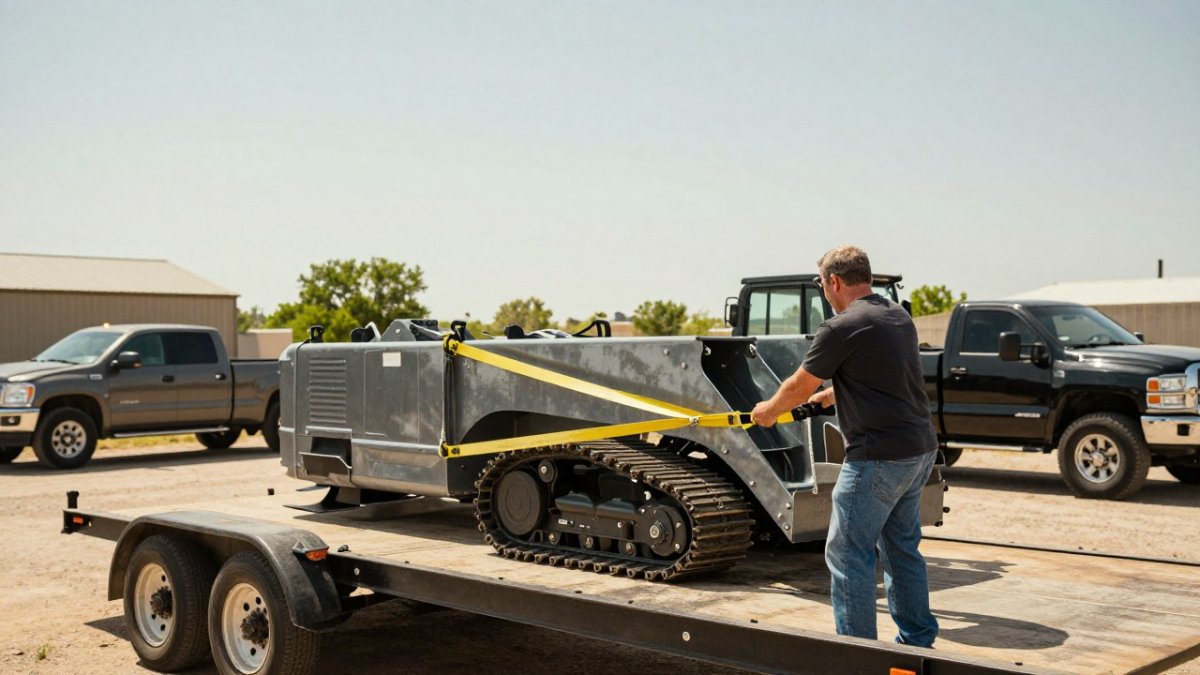
A skid steer you cannot legally or safely haul is not usable off-site. Check three numbers: the machine's operating weight, the trailer's payload rating, and your tow vehicle's rated towing capacity.
Also confirm the trailer deck width and ramp rating. A machine that fits the deck but exceeds the ramp capacity is a loading accident waiting to happen. If you are renting, ask about delivery, it can remove the towing question entirely.
A Worked Example
Suppose your heaviest routine lift is a 1,200 lb pallet of pavers, you'll use 250 lb forks, and your only access is a 48-inch gate. Matching your equipment to the correct trailer types for landscaping ensures that your machine remains stable and legal during every transit between job sites.
If you want to browse actual machines before matching one to your job, you can view the skid steer models available to rent.
Wheels or Tracks: Matching the Undercarriage to Your Ground
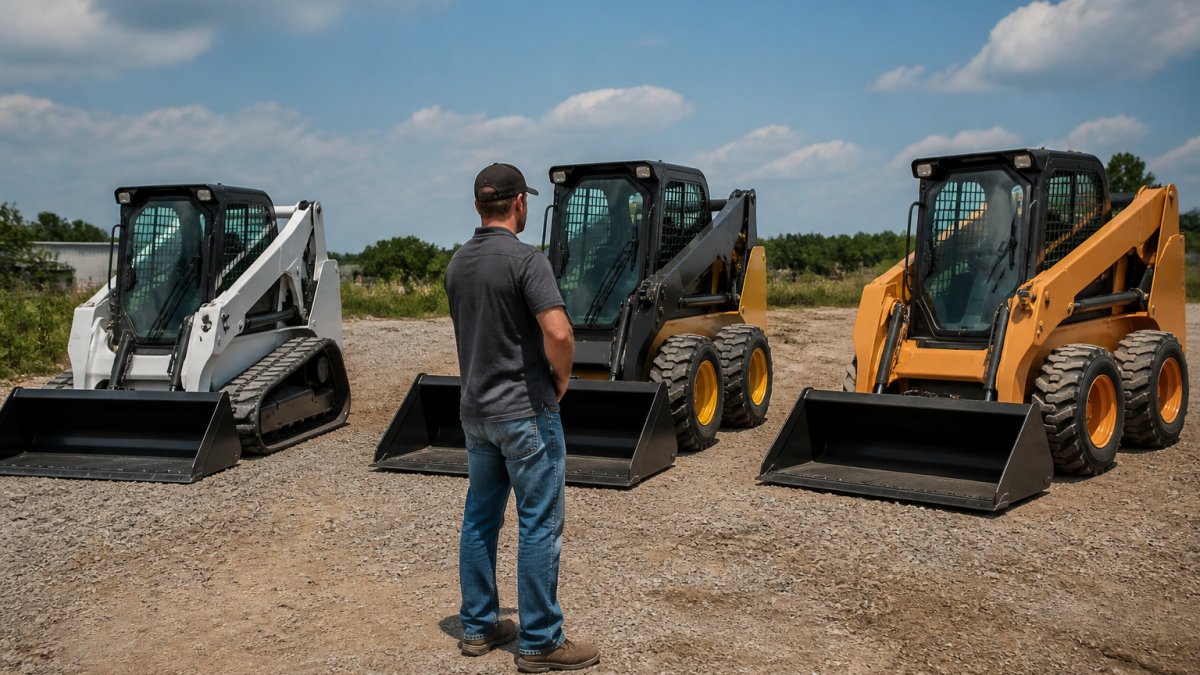
Wheels are faster, cheaper to maintain, and better on hard surfaces.
A wheeled skid steer shines on pavement, gravel, and dry, firm lots. It turns tighter, runs faster, and tires are simple to replace.
A compact track loader spreads weight across a larger footprint, lowering ground pressure. That means less rutting on lawns and better traction in mud.
- Choose wheels if: you work mostly on hard surfaces and want lower running costs
- Choose tracks if: you cross soft ground, lawns, or muddy sites often
Watch out: running tracks on sharp concrete and rock all day wears the undercarriage fast.
Radial vs. Vertical Lift: Which Lift Path Fits Your Work?
Radial lift raises the bucket in an arc, reaching forward as it rises. Vertical lift keeps the load closer to the machine and lifts higher.
Radial lift machines are the traditional choice for excavation, trenching, and grading, the arc gives reach at ground level, which helps when cutting and pushing.
If your day is mostly dirt work, radial wins. If it's mostly lifting and loading, vertical lift saves cycles.
Hydraulic Flow and Skid Steer Attachments for Landscaping
Hydraulic flow decides which attachments a skid steer can actually run, and it's the most common source of mismatched rentals. Standard-flow machines typically deliver roughly 15 to 25 gallons per minute (gpm) at around 3,000 to 3,500 psi; high-flow machines push roughly 30 to 40 gpm at similar pressure.
The quick-attach system lets you swap attachments in minutes, which is the whole point of owning or renting a skid steer. But an attachment only performs if the machine's flow, pressure, and auxiliary circuit match its requirements.
Standard Flow vs. High Flow: What Each Runs
Standard-flow hydraulics handle everyday tools: buckets, forks, grapples, augers, and most breaker hammers, the right match for grading, material handling, post-hole digging, and brush clearing.
High-flow hydraulics are needed for demanding tools that convert flow into sustained work: trenchers, rotary tillers, certain mowers, stump grinders, and high-capacity snow blowers.
A practical rule: match the attachment's required flow to the machine's rated auxiliary flow, not its total hydraulic flow. The auxiliary circuit is what feeds the attachment.
Auxiliary Circuits, Couplers, and Case Drain
Most skid steers have one set of auxiliary ports at the quick-attach plate, a pressure line and a return line. High-flow machines add a second circuit or enable switch, and some attachments require a case-drain line to protect the motor from back pressure.
Couplers matter too. Most machines use flat-face quick couplers, but older equipment and some attachments use pioneer-style or agricultural couplers. Confirm the coupler type before you commit, or plan to buy adapters.
Attachment Weight and the ROC Penalty
Every attachment eats into rated operating capacity. A bucket, forks, or grapple has its own weight, and it sits at the front of the machine, reducing what you can safely lift, a heavy grapple can consume several hundred pounds before you pick up a single log.
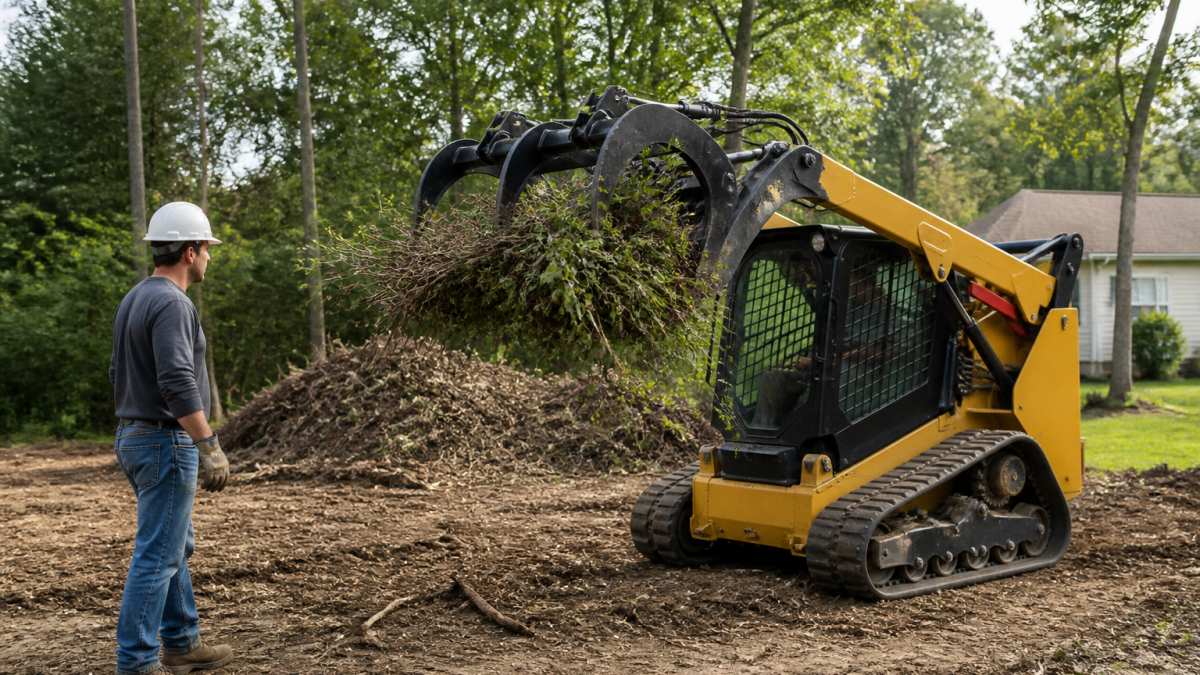
Landscaping Attachment Match-Up
- Bucket: grading and material moving, standard flow
- Grapple: brush and debris clearing, standard flow, but watch attachment weight
- Auger: post holes, standard flow; check the auger's required gpm and pressure
- Trencher: irrigation and drainage lines, usually high flow
- Tiller: seedbed prep, usually high flow
A common mistake is renting a high-flow attachment for a standard-flow machine. It stalls, overheats, or simply underperforms. Check the flow rating on both sides before you commit. To see which tools are available to rent, browse the skid steer attachments and match each one to your machine's flow.
Skid Steer vs. Tractor: Which Machine Does Your Property Need?
A skid steer turns in its own footprint and lifts loads at the front.
Skid steers win on tight sites, tight turns, and front-end lifting, grading, digging, and material handling in confined spaces.
Tractors win on acreage, mowing, and towing: faster travel, ground-engaging implements, and large open fields. On a wide farm, a tractor often does more per hour.
| Factor | Skid Steer | Tractor |
|---|---|---|
| Turning | Turns in its own footprint | Wide turning radius |
| Best ground | Tight, mixed, uneven sites | Open fields and acreage |
| Main strength | Front lifting and grading | Pulling implements, mowing |
| Attachments | Quick-attach front tools | Rear and mid-mount implements |
| Speed | Slower travel | Faster over distance |
If your work is tight-space lifting and grading, a skid steer is the better fit.
Skid Steer Rental for Residential Projects: What to Expect
Delivery is available based on distance. Renting lets a homeowner or small developer take on a one-time job without buying a machine.
Rental suits one-time projects, seasonal work, and jobs where buying can't be justified: you get the right machine and hand it back when done, keeping capital free and avoiding storage and maintenance.
Confirm the machine's size against your access and the attachments you need. For a closer look at renting for a home project, read our guide to skid steer rental for residential projects, and for budgeting, see the daily, weekly, and monthly cost breakdown.
Book Your Skid Steer and Get It Delivered to Your Site
Choosing the right machine is the hard part. Getting it to your site should be simple. Follow our step-by-step guide to renting heavy equipment to walk through the rental process.
At Diamond E Rental, delivery is available on all equipment based on distance.
We're located at Knuckleheads Hardware and serve the Brazos Valley.
Get started with Diamond E Rental and put the right skid steer on your site.
Frequently Asked Questions
What is the difference between rated operating capacity and lifting capacity?
Rated operating capacity (ROC) is the safe working load a skid steer can carry, typically about 50% of its tipping load. Lifting capacity is the maximum weight the machine can physically lift before tipping. Always size your loads to the ROC, not the tipping point. If your heaviest pallet of pavers or bucket of gravel exceeds the ROC, step up to a larger machine rather than pushing a smaller one past its limit.
Should I rent or buy a skid steer for a residential project?
For a one-time or seasonal project, renting provides access to a machine without buying one. New financed skid steer sales fell 9.6% year over year to 9,465 units from May 2025 through April 2026, per Equipment World, which suggests many buyers are weighing ownership carefully. Whether renting suits your project depends on your needs and current rental pricing.
How do I choose the right skid steer attachment?
Match an attachment to the task and check hydraulic flow first. Standard-flow hydraulics run buckets, forks, and grapples well; high-flow is needed for trenchers, mulchers, and cold planers. Confirm the attachment fits a quick-attach system and that its weight plus the load stays within rated operating capacity. For landscaping, a bucket, pallet forks, and a grapple can cover site-prep and material-handling work.
Is a skid steer or a tractor better for my property?
A skid steer turns tighter, lifts higher, and runs more attachments, which suits construction, grading, and landscaping. A tractor handles mowing, field work, and road travel better. In a skid steer vs tractor decision, pick the skid steer when your work is loading, digging, and site prep in tight spaces, and the tractor when you need PTO-driven implements across open acreage.
The hardest part of any project isn't the work itself, it's making sure the machine matches it. Diamond E Rental takes the guesswork out with quality equipment, delivery based on distance, and a team that helps you pick the right skid steer and attachments. Get started with Diamond E Rental and get the right machine delivered to your site.